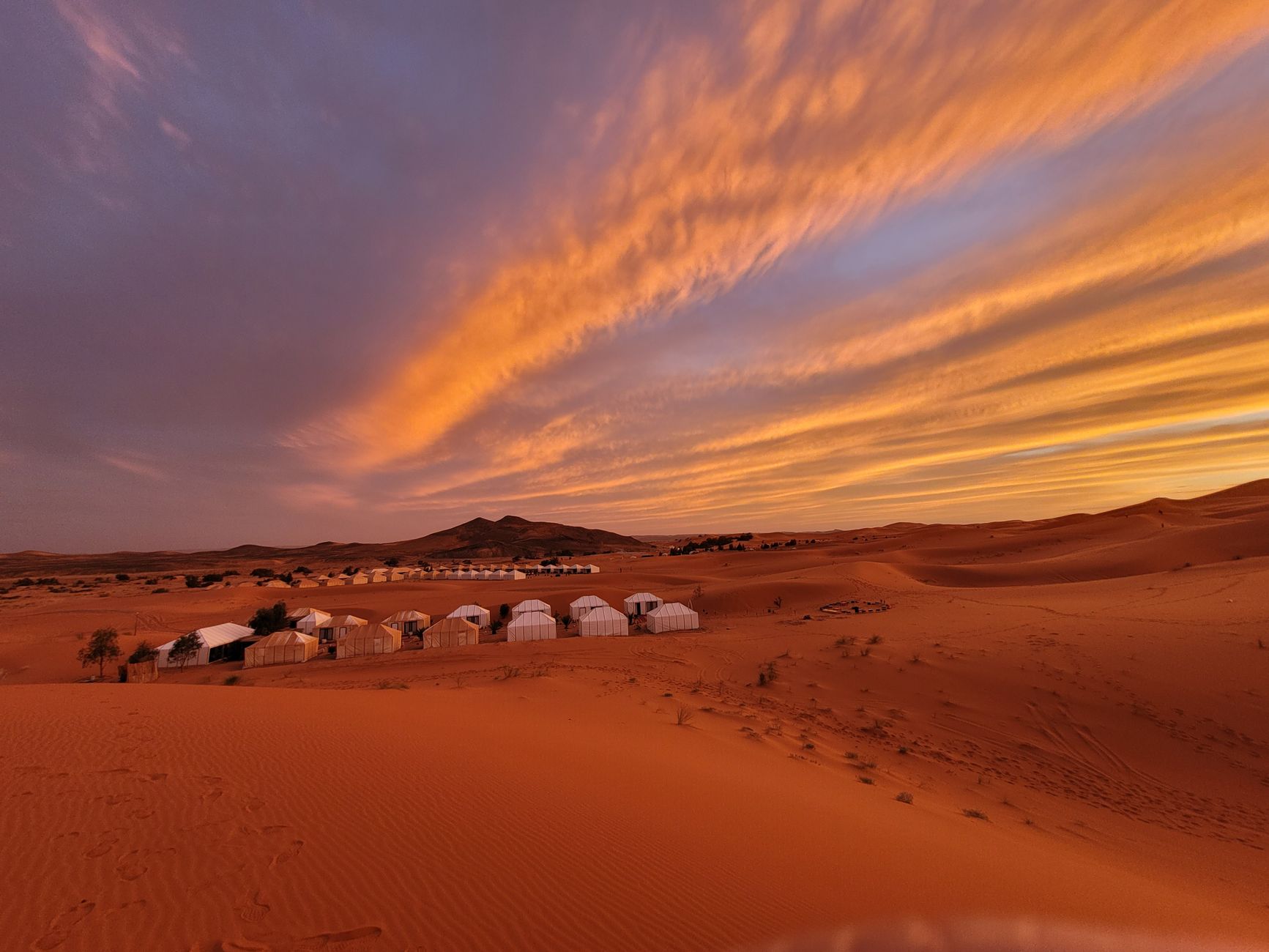
The silence hits first. Not absence of noise — presence of something older: wind carving sandstone, sand shifting against sand, a scale of time that makes your heartbeat feel like an interruption. I’ve camped in plenty of deserts. Most are just hot and empty. Wadi Rum isn’t. You sleep beneath a sky so saturated with stars it looks digitally enhanced. Bedouin tea tastes like it was invented for this exact moment. Every rock formation has a name, a story, a reason for being. If you’re going to camp in a desert once in your life, make it this one.
Overview
Wadi Rum sits in southern Jordan, about an hour north of Aqaba by car. It’s a protected area — 720 square kilometres of granite and sandstone, some of it rising 1,700 metres above the valley floor. Lawrence of Arabia passed through during the Arab Revolt, and the landscape still looks built for a cinema screen, which is why films from The Martian to Dune have used it as a stand-in for Mars. The real draw isn’t Hollywood, though. It’s the Bedouin tribes — primarily the Zalabia and Howeitat — who have lived here for centuries and now run most of the camps, guide services, and jeep tours.
Camping here isn’t one experience. Sleep in a luxury bubble dome with a private bathroom and air conditioning. Or roll out a mattress under a rock overhang with nothing between you and the Milky Way. Most travellers land somewhere in the middle: a traditional goat-hair tent or a simple stone hut, dinner cooked in a zarb (an underground sand oven), and a guide who knows which canyon catches the sunset best. The desert doesn’t care about your comfort level. It rewards anyone who shows up with curiosity and a decent pair of shoes.

Top 3 Attractions
1. The Khazali Canyon inscriptions. A narrow slot canyon in the heart of the protected area, barely wide enough to walk through in places. The walls are covered in Thamudic, Nabataean, and Islamic inscriptions — some dating back 2,500 years. What gets me every time is the detail: not just names and prayers, but drawings of ibex, camels, and human figures with spears. You’re reading graffiti older than most European cathedrals. Go early morning when the light angles into the canyon and the crowds haven’t arrived. Your guide will point out the best panels, but spend ten minutes just standing still and looking. The scale of human history compressed into a 50-metre walk is humbling.
2. Lawrence’s Spring (Ain Abu Aineh). Yes, it’s named after that Lawrence, and yes, there’s a carved inscription that may or may not be his. Ignore the scepticism. The spring itself is a thin trickle of water running down a rock face into a small pool, surrounded by fig trees and oleander. It’s a 20-minute scramble up from the road, and the view from the top — across the red sand valley toward the Jebel Rum massif — is worth every step. I’ve drunk tea here with a Bedouin named Salem who told me his grandfather used to water his goats at this exact spot. That’s the thing about Wadi Rum: the history isn’t behind glass. It’s still in use.
3. The Burdah Rock Bridge. One of the largest natural arches in the region, perched high on a ridge that takes about 90 minutes to climb. The route isn’t technical, but it’s exposed in places, and you’ll want both hands free. What makes it special isn’t just the arch itself — it’s the 360-degree view from the top. You can see the Saudi border, the Aqaba mountains, and the entire valley spread out like a relief map. I’ve watched grown adults sit down and cry at this viewpoint. Not from exhaustion. From the sheer ridiculous beauty of it. Go with a guide who knows the route; the cairns can be confusing on the way down.
Insider Tips
- Book your camp directly, not through a booking platform. The big aggregator sites take up to 30% commission, which comes out of the Bedouin family’s pocket. Find a camp you like on Instagram or word-of-mouth, then message them on WhatsApp. You’ll often get a better rate and more flexible arrangements.
- Bring cash — Jordanian dinars, small notes. Most camps don’t have card machines, and the nearest ATM is in Aqaba or Wadi Musa. You’ll need cash for tips, extra tea, and the occasional impromptu jeep detour your guide suggests. Budget 20–30 JD per day for extras.
- Sleep outside the tent if you can. I know it sounds obvious, but a surprising number of people book a desert camp and then spend the night inside a canvas structure with a zip door. The whole point is the sky. Ask your host for a mattress and blanket on a flat rock ledge. You’ll wake up with sand in your sleeping bag and a story you’ll tell for years.
- Learn three words of Arabic. Shukran (thank you), marhaba (hello), and zaki (delicious) will get you further than you’d think. Bedouin hospitality is genuine, but it’s also reciprocal. Showing that you’ve made an effort changes the dynamic from tourist-and-provider to guest-and-host.
- Don’t skip the zarb dinner. It’s a lamb or chicken stew cooked in a sealed pot buried under hot coals for hours. Every camp does it, and every camp claims theirs is the best. They’re all good. Eat with your hands, share the bread, and let the conversation wander. That’s the real Wadi Rum experience — not the landmarks, but the long, slow evening after them.
Practical Info
Getting there: The main gateway is Aqaba, which has an international airport and a border crossing from Israel. From Aqaba, it’s a 45-minute taxi or bus ride to the Wadi Rum Visitor Centre. From Amman, it’s about four hours by car via the Desert Highway. Public buses run from Amman and Aqaba, but they’re infrequent. Most travellers hire a private driver or join a tour group. Once inside the protected area, you need a 4×4 or a Bedouin guide — regular cars won’t make it past the visitor centre.
Best time to visit: October to April. November and March are the sweet spots — warm days (20–25°C), cool nights (5–10°C), and fewer crowds than the Christmas and Easter peaks. July and August are brutal; daytime temperatures regularly hit 40°C, and even the Bedouin retreat to shaded tents by noon. If you go in summer, plan all activities for early morning and late afternoon, and drink more water than you think you need.
Budget: A basic Bedouin camp with dinner and breakfast runs 25–40 JD per person per night. Mid-range camps with private bathrooms and proper beds: 60–120 JD. Luxury bubble domes: 150–300 JD. Jeep tours cost 40–80 JD per vehicle for a half-day, depending on the route and your negotiation skills. Guides for climbing or trekking: 80–150 JD per day. You can do Wadi Rum on a backpacker budget, but the extra 20 JD you spend on a better camp often buys you a much better experience.
Safety: Wadi Rum is generally very safe. Violent crime is non-existent. The real risks are environmental: dehydration, sunburn, and getting lost on unmarked trails. Always carry at least two litres of water per person for a half-day hike. Tell your camp host where you’re going and when you expect to be back. Flash floods can happen in canyons after rain — rare, but deadly. If your guide says don’t go into a slot canyon, don’t go. They know things you don’t.
A Surprising Fact
Wadi Rum isn’t just a desert. It’s a place where the rocks are alive — or at least, they’re covered in living things. The sandstone surfaces are home to dozens of species of cyanobacteria and lichen that survive on dew and occasional rain, forming dark, crusty patches that look like stains but are actually complex microbial communities. Some of these organisms are thousands of years old. They grow so slowly that a footprint left on the rock can remain visible for decades. Which means when you’re scrambling up a canyon, you might be stepping on a living thing that’s older than the Roman Empire. Try not to think about that too hard while you’re climbing.
So here’s my question for you: when was the last time you slept somewhere that made you feel genuinely small? Not in a bad way — in the way that recalibrates your sense of what matters. Wadi Rum does that. It’s not a comfortable destination, not always. The sand gets everywhere. The nights are cold. The bathroom situation is often a hole in the ground with a curtain. But you’ll come back different. Book a camp, pack a headlamp, and leave your expectations at the visitor centre. The desert will take care of the rest.